Java Function
Purpose of the plugin
With the Java function, specific customer requirements (e.g. XML and CSV exports) can be programmed directly in the OMN Configuration Client using Java and executed in OMN via the function button.
Introduction
The Java function makes it possible to program customer-specific requirements for objects in the OMN using Java.
An object can be an asset, a product or a project, for example.
Examples of applications include imports and exports that deviate from the standard OMN process, starting workflows or regenerating images.
| Depending on the complexity of the requirement, the developer decides whether the Java function can be used or whether the JavaScript Function is more suitable. |
Settings for the execution of the Java function can be activated in the OMN Configuration Client.
On the one hand, users can control whether the function can only be executed on individual objects or on multiple objects.
It is also possible to start processing asynchronously.
| Asynchronous means that objects can be edited independently of each other and not in a fixed order. |
After executing the function, a dialog with information can be displayed to the user, which can also be provided as an HTTP link.
Prerequisites and relations to other modules
To be able to execute the Java function, it must be integrated in at least one of the following modules:
How to use
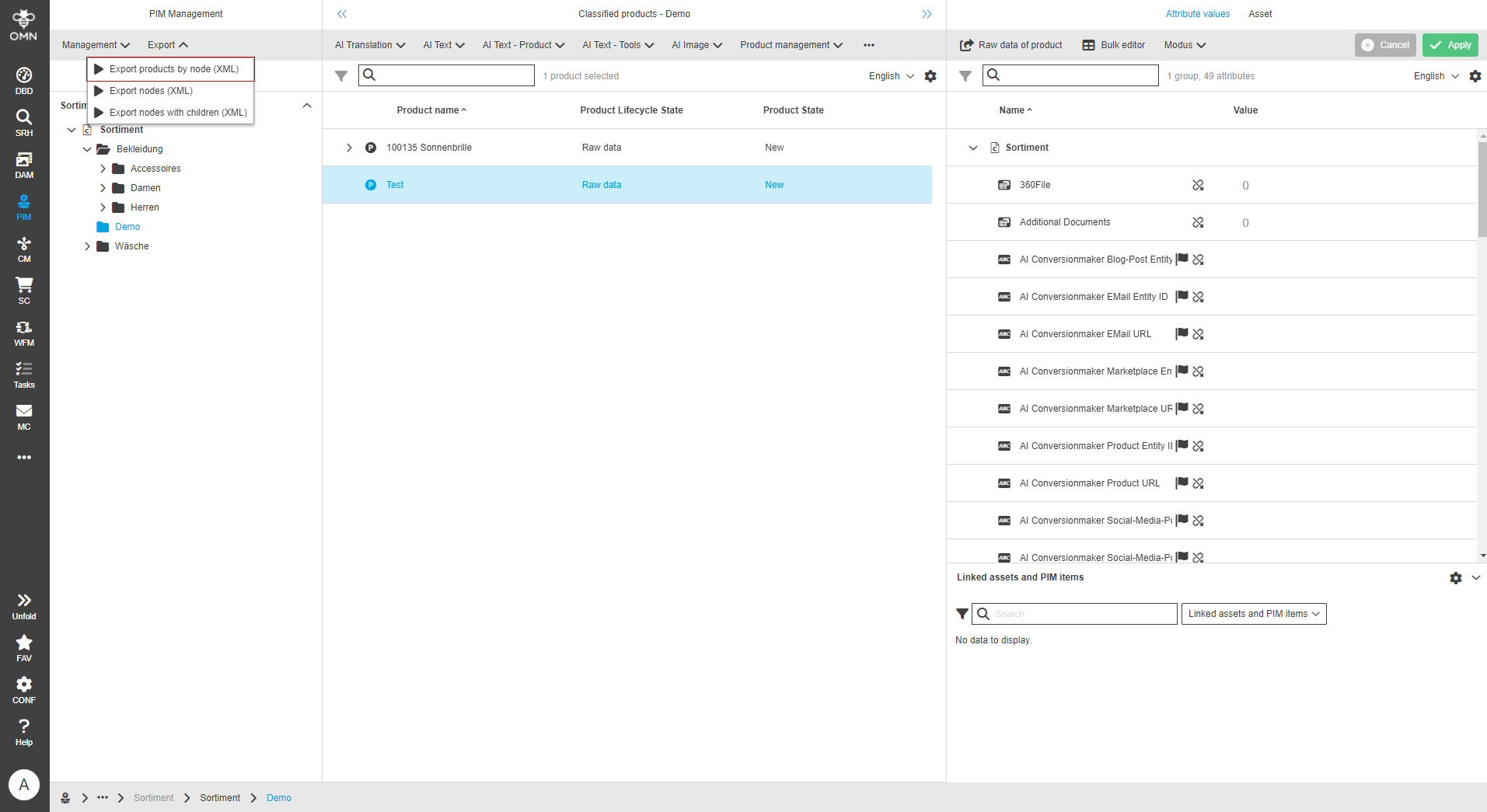
If the Java function is available, it is displayed in the toolbar after selecting an object.
It is executed by clicking on it.
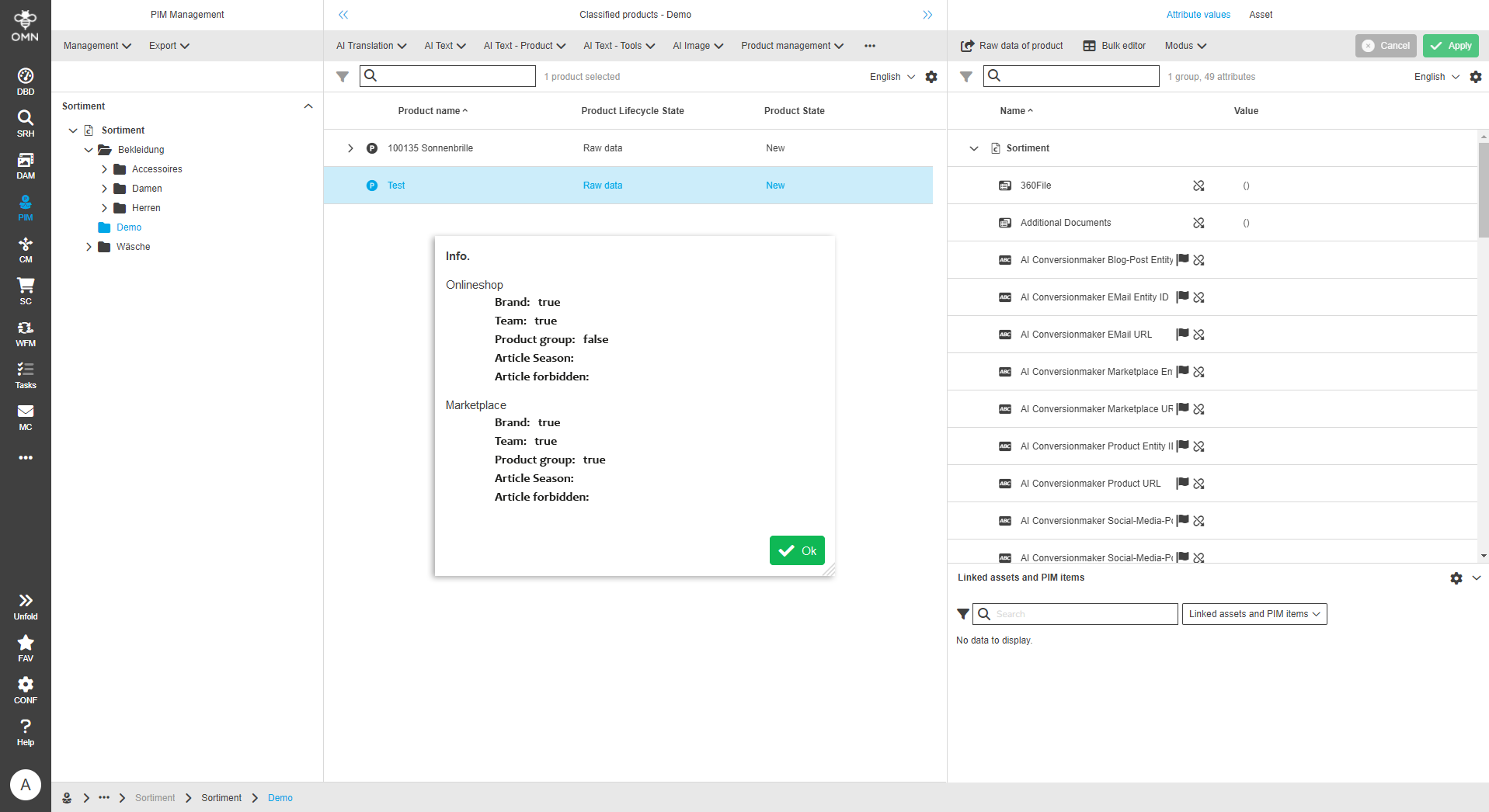
If feedback to the user is set in the configuration, this is displayed as a pop-up.
Application examples
Some use cases and examples of the Java function are listed below:
-
Validation of products for export:
Export-relevant products can be selected and validated using a Java function.
The customer receives feedback in a pop-up as to whether all the required fields are valid or still need to be checked. -
New creation of webshop images:
After selecting a product, the images linked to the product are collected and recreated for the webshop. -
Start image workflow:
After selecting a product, the images linked to the product are collected and a workflow is started for these images.
The steps within the workflow can be adapted to the customer’s specific requirements.