Microsoft Translator
Description
The Microsoft Translator is a machine translation service. The OMN integration works together with Microsoft via an API.
The Microsoft Translator is a proven, customizable and scalable technology for machine translation which is using industry standard REST technology.
More information about text translation and API can be found here.
To use the Microsoft Translator in the OMN context, a paid subscription must be purchased.
Supported languages
The list of supported languages is the following:
Afrikaans,
Albanian,
Amharic,
Arabic,
Armenian,
Assamese,
Azerbaijani (Latin),
Bangla,
Bashkir,
Basque,
Bosnian (Latin),
Bulgarian,
Cantonese (Traditional),
Catalan,
Chinese (Literary),
Chinese Simplified,
Chinese Traditional,
Croatian,
Czech,
Danish,
Dari,
Divehi,
Dutch,
English,
Estonian,
Faroese,
Fijian,
Filipino,
Finnish,
French,
French (Canada),
Galician,
Georgian,
German,
Greek,
Gujarati,
Haitian Creole,
Hebrew,
Hindi,
Hmong Daw (Latin),
Hungarian,
Icelandic,
Indonesian,
Inuinnaqtun,
Inuktitut,
Inuktitut (Latin),
Irish,
Italian,
Japanese,
Kannada,
Kazakh,
Khmer,
Klingon,
Klingon,
Korean,
Kurdish (Central),
Kurdish (Northern),
Kyrgyz (Cyrillic),
Lao,
Latvian,
Lithuanian,
Macedonian,
Malagasy,
Malay (Latin),
Malayalam,
Maltese,
Maori,
Marathi,
Mongolian (Cyrillic),
Mongolian (Traditional),
Myanmar,
Nepali,
Norwegian,
Odia,
Pashto,
Persian,
Polish,
Portuguese (Brazil),
Portuguese (Portugal),
Punjabi,
Queretaro Otomi,
Romanian,
Russian,
Samoan (Latin),
Serbian (Cyrillic),
Serbian (Latin),
Slovak,
Slovenian,
Somali (Arabic),
Spanish,
Swahili (Latin),
Swedish,
Tahitian,
Tamil,
Tatar (Latin),
Telugu,
Thai,
Tibetan,
Tigrinya,
Tongan,
Turkish,
Turkmen (Latin),
Ukrainian,
Upper Sorbian,
Urdu,
Uyghur (Arabic),
Uzbek (Latin),
Vietnamese,
Welsh,
Yucatec Maya,
Zulu
All languages can be seen on this page.
| The languages can be adapted by the providers, which may result in discrepancies between the page and the languages actually supported. |
Configuration Parameters
Workflow-Name: ai-translation
General parameters
| Key (* = required) | Type | Default | Description | Example |
|---|---|---|---|---|
ext.ai-translation.translationService* |
string |
Name of the AI translation service which should be used ('deepl', 'ms', 'google' or 'systran') |
deepl |
|
ext.ai-translation.attributes |
string (multi) |
List of attribute identifiers which should be translated (per default all language dependant attributes are translated) |
"Artikelnummer, Farbe" |
|
ext.ai-translation.sourceLanguages |
language (multi) |
required |
List of content source languages which should be translated |
English, German |
ext.ai-translation.targetLanguages |
language (multi) |
required |
List of content target languages which should be translated to |
French, Japanese |
Microsoft specific parameters
| Key (* = required) | Type | Default | Description | Example |
|---|---|---|---|---|
ext.ai-translation.ms.apiUrl* |
string |
Base URL of the ms translation service |
||
ext.ai-translation.ms.apiKey* |
string |
API Key for the ms translation service |
Example configuration
The following image shows what a sample configuration for Microsoft Translator might look like.
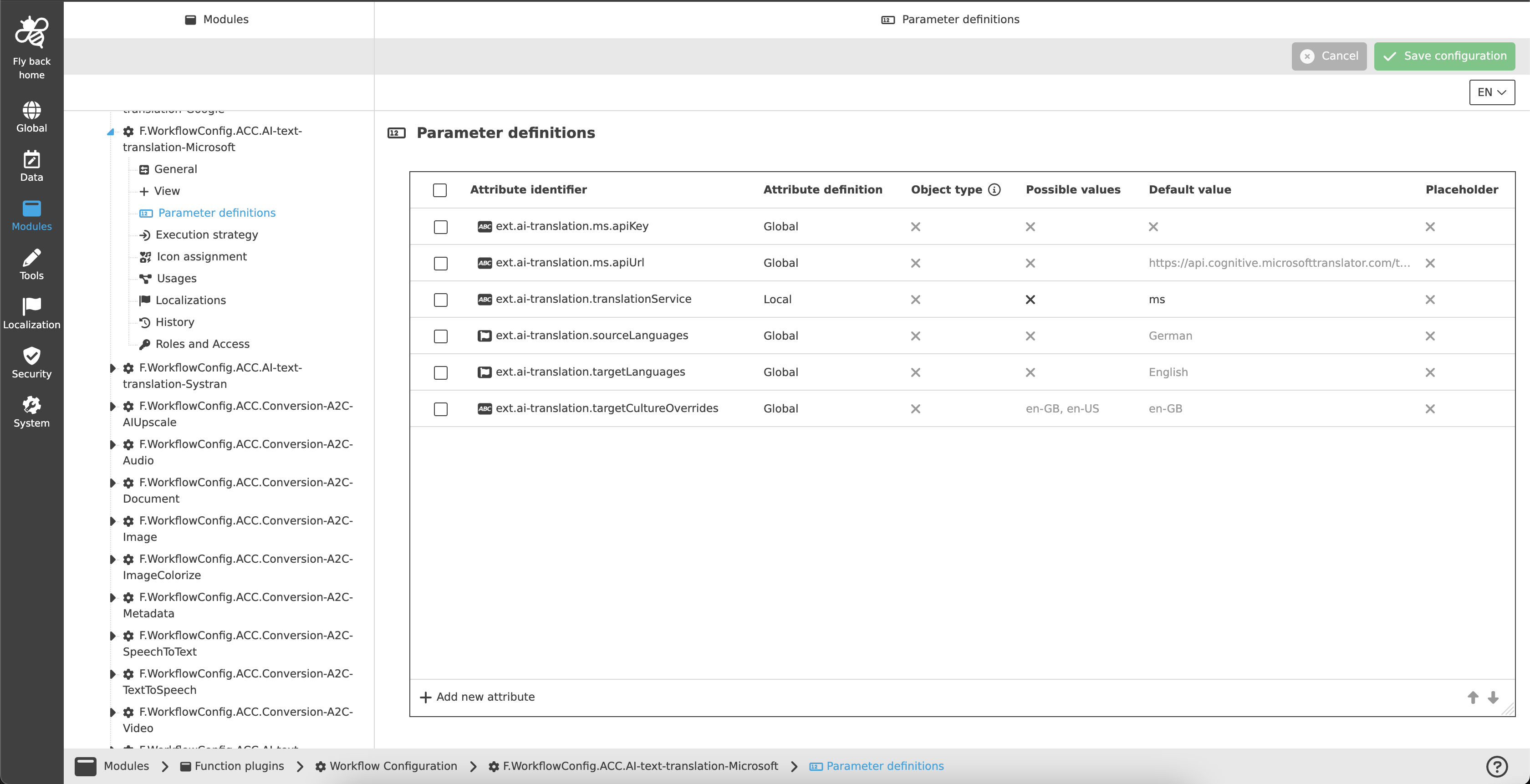
A detailed step-by-step guide to the configuration of the Workflow Config Function plug-in can be found on this page.