OMN API
OMN offers application programming interfaces (APIs) that can be used to integrate OMN into your applications and perform operations like upload/manage/retrieve OMN data, automate/manage/start workflows, retrieve status information.
| With OMN 7.0, the API documentation moves to the interactive API documentation sub-site: endpoint reference pages generated from every OMN build, an embedded Swagger-UI with per-cluster definitions (PIM, DAM, CM, …) and the developer guides — always in sync with the product. |
Introduction
The OMN APIs are REST over HTTP-like APIs used to create integrations/interactions between OMN and other applications. They offer endpoints so that API clients (like UI or 3rd party clients) can communicate with OMN over the network.
An API endpoint is a digital location accessible through the API and from which the API receives requests and returns responses from API clients. Each endpoint is represented by a URI that indicates the location of a resource (a file or an OMN data model object) on the API server.
To understand the basic concepts of the OMN API please read Common Concepts.
Available APIs
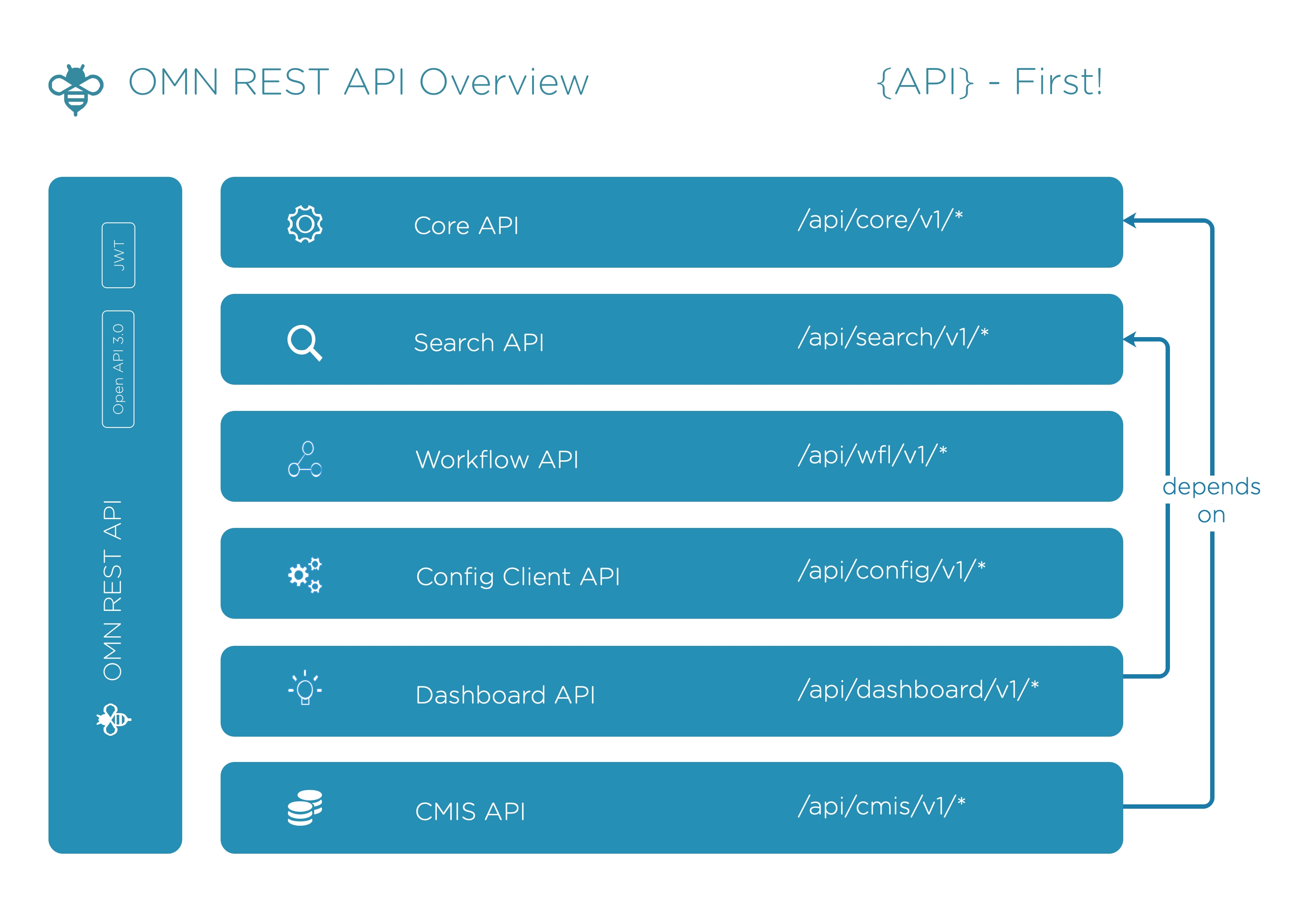
| API | Description |
|---|---|
offers endpoints that cover the main OMN modules (DAM, PIM, CM, PEO etc.) to retrieve/manage (CRUDe) the module’s resources (data objects) like Assets, Versions, Variations, Directories, Products, Classifications, Projects, Keywords, Glossaries and others. |
|
offers endpoints for searching (full-text, combined (e.g. facet search), sub-searches (Join)) in the supported OMN resources. |
|
offers endpoints to manage Processes (aka workflows), Tasks, Jobs etc. |
|
Configuration Client API |
offers endpoints to manage OMN configurations (system, plugins, functional components, mandator settings, etc.). |
offers endpoints to manage OMN dashboards or dashboard data. |
|
offers Content Management Interoperability Services (CMIS) standard conform endpoints to get repositories, objects etc. |