Content Delivery Network, Amazon CloudFront and Lambda Service
Content Delivery Network
A Content Delivery Network (CDN) is a network of geographically distributed servers that accelerates the delivery of web content by bringing it closer to the user. This is done through caching, where copies of files are temporarily stored in data centers around the world, allowing you to access internet content via a server near you. When content is delivered from a nearby server, it shortens page load times and provides a faster, more efficient web experience.
CDNs consist of three main components:
-
Origin Servers: Contain the original versions of the content.
-
Edge Servers: Located at various geographical locations and store cached content.
-
DNS Servers: Manage the IP addresses of the origin and edge servers.
The main benefits of a CDN are reduced latency, improved availability, and enhanced security. They help to boost website performance by delivering content closer to the end user and balancing traffic.
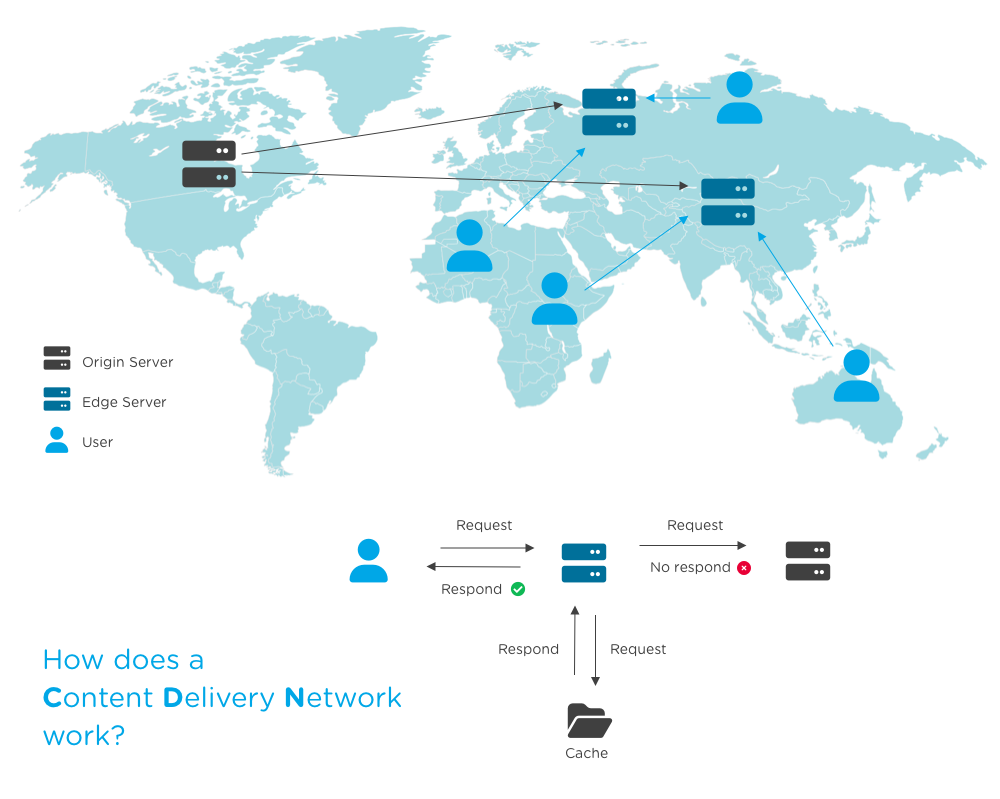
| You can find more detailed information about CDN use within OMN here |
Amazon CloudFront
There are many Content Delivery Network (CDN) solutions that vary depending on your needs and budget.
Amazon CloudFront is a web service designed for content delivery (CDN). It integrates with other AWS cloud services to
provide developers and businesses with an efficient way to distribute content globally.
CloudFront offers low latency and high transfer speeds without requiring a minimum usage commitment.
Key features of Amazon CloudFront include:
-
Global Distribution: Content is delivered from the nearest point of presence (PoP) to the user, reducing latency.
-
Integration with AWS Services: Seamlessly works with services like Amazon S3 for content storage, EC2 for web applications, and AWS WAF for advanced firewall features.
-
Enhanced Security: Standard HTTPS delivery, built-in DDoS protection with AWS Shield Standard, and integration with AWS Certificate Manager for SSL/TLS certificates.
-
Performance Optimization: On-the-fly compression of certain files and smart routing using machine learning to determine the fastest path for traffic.
| You can find more detailed information about Amazon CloudFront here |
Lambda Service
AWS Lambda is a serverless computing service from Amazon Web Services (AWS) that allows you to run code without provisioning or managing servers. With AWS Lambda, you can write and upload code in various programming languages, and the code is automatically executed when certain events occur, such as uploading a file to an Amazon S3 bucket or receiving a message in an Amazon SQS queue.
The main features of AWS Lambda are:
-
Automatic Scaling: Lambda automatically scales the number of running instances based on the number of incoming events.
-
Cost Savings: You only pay for the compute time you actually use, with no charges when your code is not running.
-
Easy Integration: Lambda seamlessly integrates with other AWS services, making application development easier.
These two services are essential components of modern web applications and offer significant advantages in terms of performance, scalability, and cost.
| You can find more detailed information about Lambda Service here |