Mapping Editor
Purpose of the plugin
The Mapping Editor is used to assign or map Excel or CSV data to OMN data models, thereby simplifying the import of files into OMN.
Introduction
With the Mapping Editor, it is possible to assign source attributes to a specific OMN attribute (target attribute) in PIM using a mapping file (reference file).
This can be done either using a 1:1 mapping directly via the table or using transformations, in this case also with multiple source attributes.
In addition to Attribute Mapping, there is also the Key Attribute Mapping and the Classification Path Mapping.
Prerequisites and relations to other modules
To use the Mapping Editor, the Import Profile plugin must be available on the system.
In addition, PIM classifications and attributes as well as an import profile must be created in order to use the Mapping Editor.
The import processes can also be tracked in the Import - Process Controller plugin.
How to access
The Mapping Editor can be opened using the “Open Mapping Editor” function in the Import Profile via the toolbar.
How to use
The Mapping Editor is always divided into a left and center view.
The left view is always structured the same, whereas the center view differs depending on the selection (content switcher).
-
Left View
Table with source attributes from the reference file
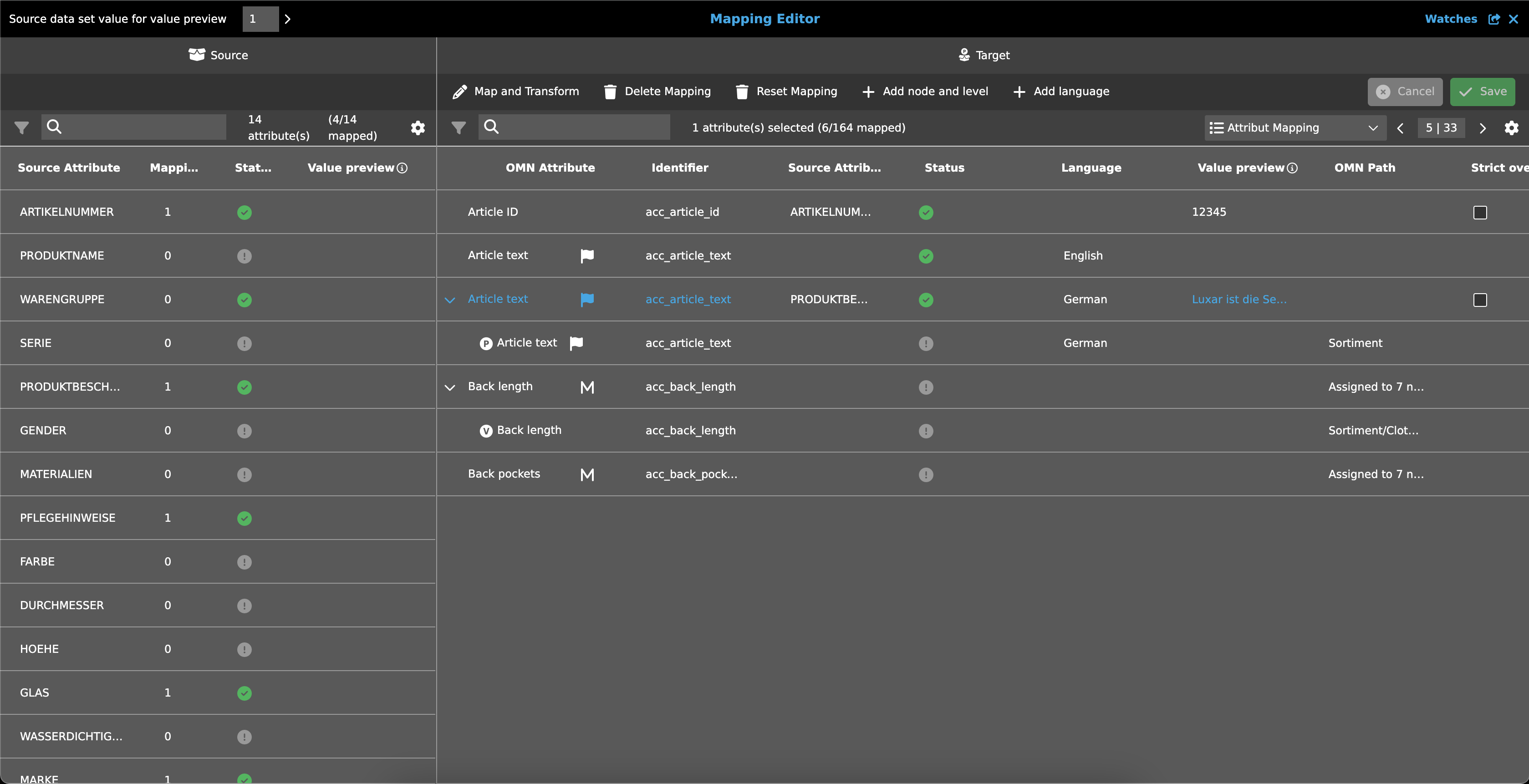
Title bar
The title bar contains the name of the plugin: Mapping Editor.
On the left side of the title bar is the “Source data set value for value preview” switcher.
It includes pagination to navigate through the various preview values of the mapping file and see different value examples in the left view.
On the right side of the title bar, the user can find the name of the import profile. Next to it, in brackets, is the name of the mapping file.
There is also a button to open the editor in a separate tab and a close button.
Left View
The left panel contains an overview of all source attributes, i.e., all attributes provided by the mapping file.
The title of the left panel consists of an icon (box) and the word “Source.”
Statusbar
The statusbar contains a quick filter, an object counter and settings.
Quick filter & Object counter
A quick filter function is available to users to reduce source attributes and simplify the search for specific attributes.
One or more values can be entered here to find the desired attribute.
Next to the quick filter function is an object counter that displays the number of source attributes and assigned attributes.
Canvas
The workspace displays a table containing all source attributes (attributes from the mapping file).
The table contains the following columns:
-
Source Attribute
-
Icon column
-
 Key attribute (as soon as mapped)
 -
 Classification path (as soon as mapped)
-
-
Mappings
The column shows the number of mappings performed for this attribute.
Each time this attribute is used for mapping, the number increases by 1.
When the mouse pointer is moved over the value, a tooltip appears showing the mapped attributes (separated by commas), indicating the OMN attribute name and identifier.Assignments of key attributes or classification paths have no influence on the number. -
Status
-
Gray
No mapping performed. -
Red
Error during mapping (e.g., the assigned OMN attribute is no longer available). -
Green
At least one attribute has been successfully assigned. -
Yellow
There is at least one error among the mappings (e.g., of two mappings, one is successful and one is faulty).
-
-
Value preview
-
The value preview displays the corresponding source data that was set using the title bar.
-
An information icon is located next to the title, which displays the following tooltip:
“Display of the mapped OMN target attribute result (applied actions are taken into account)”
-
Center View
Users can choose from three views, which are described in more detail on the following subpages:
-
Attribute Mapping
Overview of all OMN attributes and their assigned source attributes -
Classification Path Mapping
Used for assigning or mapping classification paths -
Key Attribute Mapping
Used for the unique identification of a product
In addition, users have access to a transformation function for mapping, which goes beyond simple 1:1 mapping (OMN attribute to source attribute) and allows combinations of multiple source attributes.
The title of the middle view always consists of an icon (PIM) and the word “Target.”