PIM (Product Information Management)
Product Information Management (PIM) is a tool for the central creation, maintenance, management and enrichment of product information for all output channels. It includes the display and maintenance of product features (texts, attributes, properties) as well as the display of item master data transferred from ERP systems and their enrichment with PIM-specific marketing features. The goal is to create a "golden record" from rudimentary master data that can be used in all channels. Another function is DQM processes, which are used to achieve and monitor channel-specific data quality. In addition, product-related content such as images, videos, audio files or documents can be referenced to products there and prepared for output to the various marketing channels.
It is also possible to define classifications and attributes, create and group products, articles and variants (one- to three-level hierarchy), assign the created attributes to classes (so that they are only displayed for the articles of this class) and maintain field contents/attributes.
For more information, visit apollon | PIM
Access to the plugin
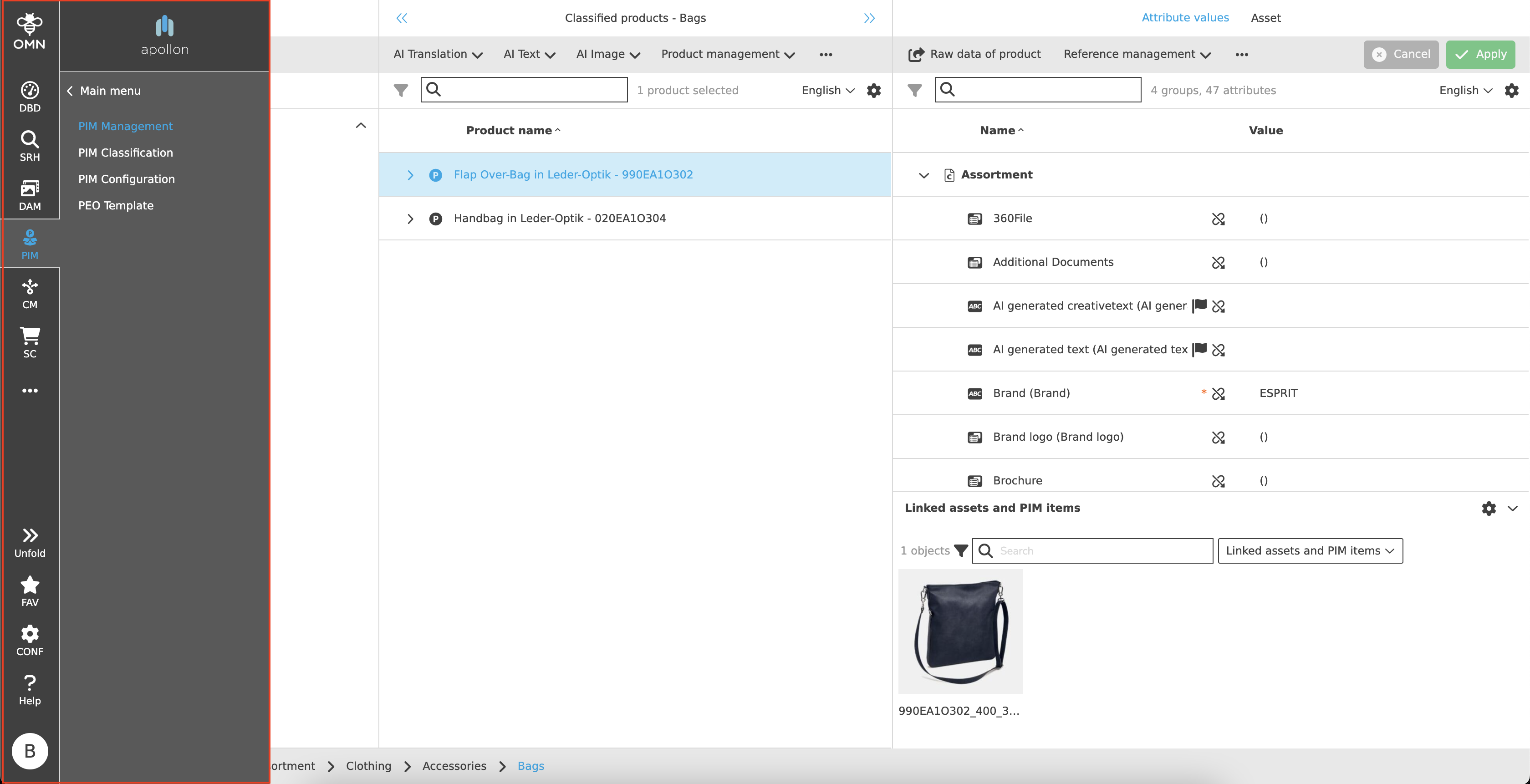
The PIM module can be opened via the sidebar. To do this, the corresponding menu item is selected, whereby up to four different views can be displayed:
-
Configuration View: Configuration area for creating the PIM data model with associated attributes.
-
Classification View: Classification area for classifying unclassified items.
-
Management View: Maintenance of attributes for products based on the underlying data model.
-
Template View: Area for creating so-called PEO templates for different output channels and defining relevant attributes and their behavior.
Structure
Each view is divided into three columns, as described in general structure.
The left view shows the classification nodes, the center and right views are used for the configuration, classification and maintenance of products.
Detailed information on the respective views and the structure can be found in the respective sub-chapters: